
Porsche Wants Its Old EV Batteries To Come Back As New Ones
Porsche has produced pilot battery cells using cathode material made entirely from recycled lithium, nickel, cobalt and manganese recovered from its own end-of-life high-voltage batteries


Porsche is taking another step toward closing the loop on its electric car batteries, but the latest development goes beyond simply recycling old battery packs. The automaker has produced battery cells whose cathode active material was made entirely from recycled raw materials recovered from Porsche’s own high-voltage batteries.
The pilot project, carried out with German battery recycling company cylib and other partners, is now moving into real-world testing. The development is significant because recycled material is no longer just being recovered and processed for potential future use. Porsche has now put it back into new battery cells.
Porsche Is Recycling More Than Just The Battery Pack
The project focuses on recovering valuable materials from end-of-life high-voltage batteries, including lithium, nickel, cobalt and manganese. Those batteries are first discharged and dismantled before being mechanically shredded. The resulting material is processed into what is known as black mass, from which the individual raw materials can be recovered and refined.
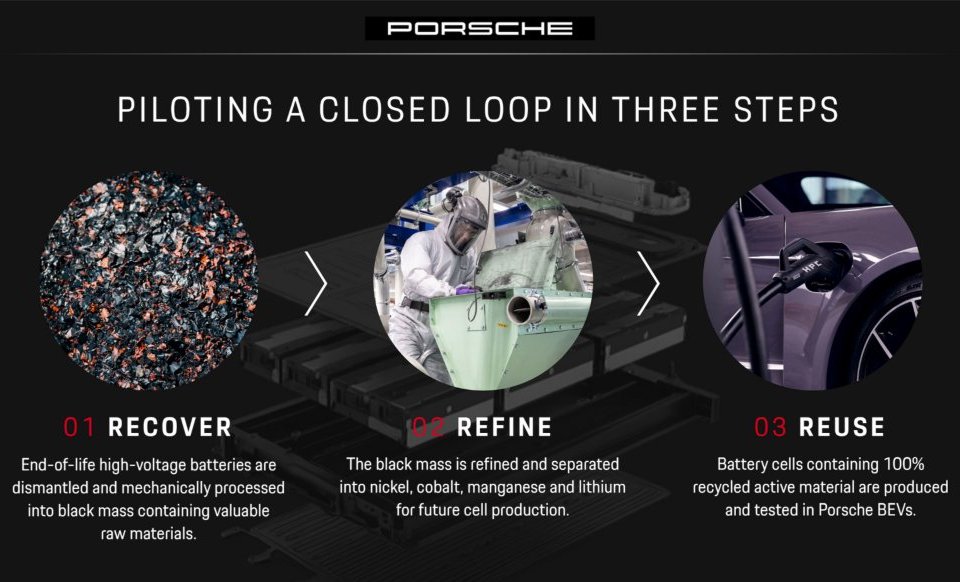
Porsche and its partners have now used those recovered materials to produce cathode active material without adding conventionally sourced primary raw materials. The resulting cells are being tested under real-world conditions.
As per the automaker, the initial testing has already indicated that the approach is technically feasible, although further results are expected during the second half of 2026. The company is yet to establish whether the recycled materials can meet the quality, performance and durability requirements needed for series-production battery cells.
The Materials Came From Porsche Batteries
The closed-loop element is particularly notable. Porsche says the raw materials used for the pilot cells came exclusively from its own high-voltage batteries. Since May 2026, end-of-life batteries collected from Porsche Centres in Germany have been processed through cylib's water-based recycling process.
The recovered materials are being tracked through a dedicated material account. Porsche says the recycled battery materials are expected to become available to the company and selected partners for battery-cell production from 2028. The eventual goal is to use recycled battery materials recovered in Europe in high-voltage batteries for Porsche vehicles.
Porsche Is Still Testing The Idea
The latest cells do not represent the immediate arrival of fully recycled batteries in Porsche's production cars. It is still in the pilot phase, with the cells undergoing extensive testing. The automaker has mentioned that the next stage is to determine whether the recovered materials are capable of delivering the required value, quality and performance for battery applications.
The company plans to use the findings from the project to assess whether the recycled materials could eventually be incorporated into series-production battery cells. The approach also has a supply-chain objective. Recovering lithium, nickel, cobalt and manganese from batteries already in circulation could thus help the automaker reduce its dependence on newly sourced raw materials and some of the global supply chains behind them.
The Recycling Partner Is Scaling Up Too
For the project, Porsche has joined forces with cylib, which is a German battery recycling company founded in Aachen in 2022. Its recycling process combines mechanical processing with hydrometallurgical recovery, and cylib is currently expanding its operations in Germany. In July, cylib announced plans around a facility in Wernberg-Köblitz, Bavaria, that is said to be capable of handling up to 10,000 metric tonnes of end-of-life EV batteries every year once fully operational.
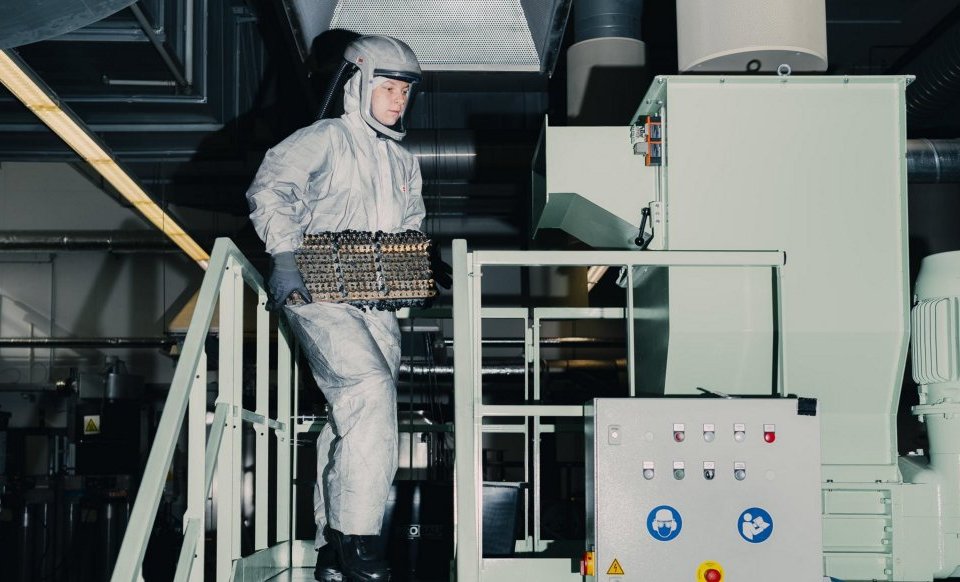
Porsche's pilot project therefore comes as its recycling partner is also working toward larger-scale battery processing. For Porsche, the immediate milestone is narrower: materials from its own old high-voltage batteries have now made their way back into new battery cells. Whether that can eventually become part of series production will depend on the testing still underway.
Recommended Articles

The World of BRABUS: Everything the German Tuning Giant Does Beyond Cars

The Ford Bronco Filson Is A Luxury Bronco That Still Wants To Go Off-Road

Project Endgame: An Ironman-inspired Guntherwerks 911
The Mercedes CLE 646 Spezialanfertigung Is A V8 Track Special We Never Saw Coming

Porsche Turned Paint Into One of Its Most Exclusive Options (PTS)

Reimagining the Air-Cooled Icon: The Most Famous Porsche Restomod Companies

Porsche Sonderwunsch: Inside the Bespoke One-Off Program

8 Used Performance Bargains That Can Outrun a 2027 Corvette Stingray

10 Most Luxurious Sedans You Can Buy In America Right Now

Volkswagen ID.3 GTI Debuts With 326 HP And Rear-Wheel Drive

Volvo Gives Its XC60 And XC90 Plug-In Hybrids More Than Twice The Electric Range

Join the Conversation
Comments
Loading comments…
No comments yet. Be the first to start the conversation.